Forrest Mallard - March 7, 2025
I. Introduction
A Midnight Offering to the City of Budapest

Tucked away in a quiet corner of Budapest’s City Park, perched ten feet above the ground on the Vajdahunyad Castle facade, a Béla Lugosi bust silently observes the world below. It wasn’t commissioned, nor was it formally installed. It simply appeared one night in 2003—a spectral offering to a city that once called Lugosi its own.
Who Was Béla Lugosi? The Man Behind the Myth
Before he became the face of Hollywood horror, Béla Lugosi was just another Hungarian dreamer. Born Béla Ferenc Dezső Blaskó in the small town of Lugos (now Lugoj, Romania), he honed his craft in Hungarian theater before fate—and a thick Transylvanian accent—sealed his destiny in the gothic corridors of Hollywood.
The Mystery of the Béla Lugosi Bust

The bust was not erected with fanfare or city approval. Instead, German artist Hartmut Zech smuggled it into Budapest, seeking a permanent home for his creation. With the help of friends, he affixed it onto the castle’s facade in the dead of night. More than two decades later, it remains—an unspoken tribute to the man who embodied Dracula.
II. Béla Lugosi: The Hungarian Who Became Dracula
From Lugos to Hollywood: The Rise of a Horror Icon
Lugosi’s early years were spent on the stage, performing Shakespeare and Hungarian dramas. But ambition, war, and political turmoil forced him to flee. He arrived in the United States as an immigrant with a dream and an accent that made him an outsider.
The 1931 Dracula: A Role That Became a Curse

In 1931, Universal Pictures released Dracula, and Lugosi’s portrayal of the bloodthirsty count became the definitive interpretation. His hypnotic gaze, deliberate delivery, and aristocratic menace set the standard for all future portrayals. But it also shackled him to the character, leading to typecasting and financial struggles.
The Making of Universal’s Dracula (1931)
Life After Dracula: Struggles, Shadows, and Ed Wood

Hollywood is cruel to those it no longer needs. Lugosi found himself trapped in B-movies, struggling with addiction, and eventually working with schlock filmmaker Ed Wood. His final years were marked by poverty, yet he remained committed to his craft, dying with the same dramatic flair that defined his life.
The Legacy of Plan 9 From Outer Space
III. The Artist Behind the Bust: Hartmut Zech

The German Sculptor and His Guerrilla Art Installations
Zech wasn’t your typical sculptor. His art wasn’t displayed in galleries or auctioned to collectors. Instead, he planted it where he believed it belonged, often without permission. The Lugosi bust was his fifth international installation.
Hartmut Zech’s Other Art Installations
The Secret Mission to Install the Lugosi Bust
With the bust concealed in his luggage, Zech traveled to Budapest, scanning the city for a fitting location. He found it in Vajdahunyad Castle—a gothic structure eerily reminiscent of the castles in classic horror films. Late at night, armed with adhesive and determination, he and his friends mounted the sculpture, leaving behind an anonymous gift to the city.
Other Underground Artworks by Zech

Before Lugosi, Zech had already left his mark elsewhere. A Jim Morrison bust in Paris. A secret Lenin statue in Berlin. A tribute to Pink Floyd’s Syd Barrett in Cambridge. His art was more than sculpture—it was rebellion.

IV. The Installation: An Act of Artistic Rebellion
Why City Park? The Choice of Vajdahunyad Castle
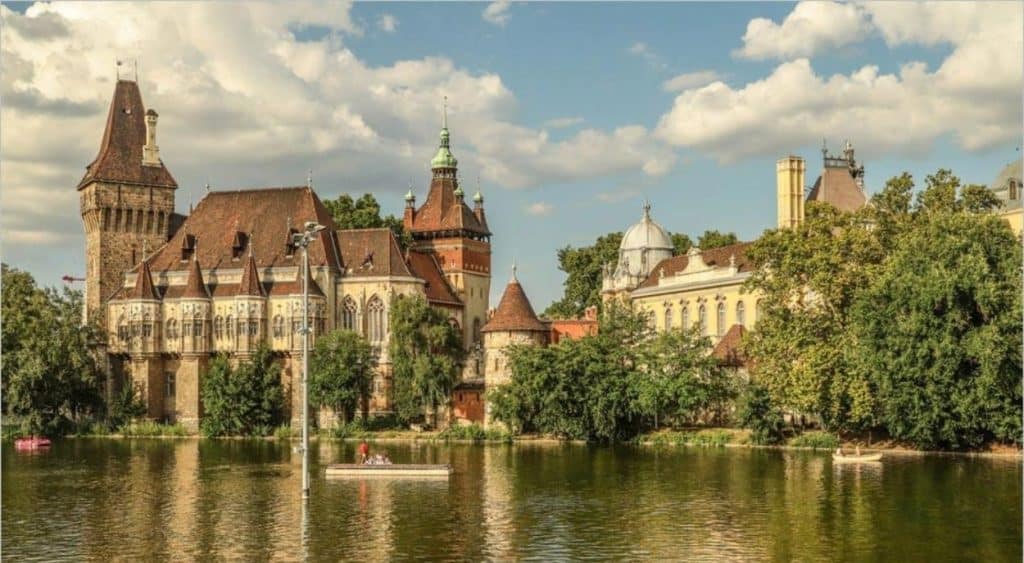
Vajdahunyad Castle is a Frankenstein’s monster of architecture—a collection of medieval, baroque, and gothic elements pieced together. It was the perfect resting place for Lugosi’s likeness, blending seamlessly with the eerie, centuries-old structure.
A Midnight Operation: How the Bust Was Secretly Mounted

No fanfare. No permission. Just a group of friends, a statue, and a plan. Scaling the castle facade, Zech secured the bust ten feet up, ensuring it would be seen but not easily removed. Then, they vanished into the night.
Local Reaction: Disbelief, Amusement, and Approval
The bust’s sudden appearance baffled locals. Some believed it was an official tribute; others thought it was an elaborate prank. Eventually, city officials decided to let it remain, an unofficial but beloved addition to the cityscape.
V. The Lugosi Bust Today: A Forgotten or Celebrated Relic?
How the Bust Became an Official (Unofficial) Part of the Castle
Over time, the Béla Lugosi bust gained recognition. Tourists, horror enthusiasts, and locals embraced it. Though technically unsanctioned, it has become an accepted, if unorthodox, part of Budapest’s artistic heritage.
The Dracula Head Gorilla Artwork: A Surreal Companion
Nearby, another bizarre piece of public art: a grotesque gorilla head, staring blankly into the distance. Whether by coincidence or cosmic humor, the pairing of Lugosi’s Dracula and the ape-like visage creates a strange harmony.
Finding the Bust: A Pilgrimage for Horror Fans
For those who seek it, the Béla Lugosi bust remains an offbeat attraction. Hidden in plain sight, it is a pilgrimage site for cinephiles, horror aficionados, and lovers of the macabre.
VI. Béla Lugosi’s Legacy in Hungary and Beyond
Hungary’s Complicated Relationship with Its Horror Hero
Despite his international fame, Lugosi’s connection to Hungary is complex. Revered as a legend but never fully embraced in his homeland, his legacy is a mix of pride and ambivalence.
Dracula Tourism: How Lugosi’s Name Still Draws Crowds
The Dracula mythos continues to fuel tourism across Eastern Europe. While Transylvania claims the vampire legend, Budapest quietly celebrates its own Dracula—the man who brought him to life.
The Enduring Myth of Lugosi and His Eternal Connection to Dracula
Even in death, Lugosi remains the definitive Count Dracula. His portrayal continues to haunt pop culture, ensuring that, like the vampire he played, he will never truly die.
The Influence of Béla Lugosi on Horror Cinema
VII. Conclusion
The Hidden Gems of Budapest: A City Full of Unexpected Wonders
Budapest is a city of mysteries—of ruin bars, hidden courtyards, and silent statues that tell forgotten stories. The Lugosi bust is one of these treasures, a secret waiting to be discovered.
Guide to Finding Hidden Statues in Budapest
The Béla Lugosi Bust: A Testament to the Power of Passion and Persistence
Zech’s defiant act of artistic homage ensures that Lugosi remains a part of his homeland. A man who played an immortal creature now has a fittingly immortal tribute—quiet, unexpected, and enduring.
Comments
Leave a Reply

Meet the Head Tramp
Forrest Mallard is a travel writer, filmmaker, and adventure guide who has dedicated his life to exploring the world and sharing its stories. With over 50 countries deeply explored, his blog, Tramposaurus Treks, has become a trusted resource for adventurers, even earning recommendations from national tourism boards.
Forrest’s storytelling spans multiple mediums, from documentary filmmaking to in-depth travel writing, often weaving history, culture, and personal experiences into compelling narratives. His acclaimed documentaries on the Walt Disney Company have even earned the rare praise of former Disney CEO Michael Eisner—a testament to his ability to uncover and present compelling stories. His professional background is as varied as his passport stamps—ranging from adventure guiding in Ecuador, Thailand, and Alaska to producing large-scale entertainment in Dubai, managing concert tours in South Africa, and even working aboard National Geographic Expedition ships. This eclectic career path has armed him with a unique perspective: one that blends logistical expertise with an insatiable curiosity for the unknown. Whether leading travelers through rugged landscapes, crafting historical documentaries, or sharing insights on long-distance trekking, Forrest remains dedicated to inspiring others to explore, connect, and embrace adventure—preferably with a well-worn backpack and a good story in tow.

TRAVEL PLANNING


LesterPam
This was a marvelous discovery. I’ve visited Budapest a few times, admired its grand buildings and hidden courtyards, but I never knew there was a secret tribute to Béla Lugosi tucked into the façade of Vajdahunyad Castle — a ghostly, midnight-mystery bust, quietly honoring the man behind the original Dracula. Your narration made the story feel alive: the midnight installation, the tension of rebellion, the way a sculpture can stand in defiance of convention and yet root itself in a city’s memory. I was particularly struck by your insight into how the bust is more than a statue — it’s a bridge between history, cinema, identity, and collective nostalgia. The fact that a sculptor from outside Hungary, through stealth and respect, could plant something so surreal and lasting shows how art transcends borders. Next time I’m in Budapest I’m going to wander City Park just to find that corner of the castle and pay my respects. Thank you for opening my eyes.
Forrest Mallard
Thank you so much for this beautiful reflection. I love that you saw the bust not just as a curious artifact, but as a kind of living symbol — part memory, part myth, part love letter to Lugosi and to Budapest itself. For me, that’s exactly what travel and storytelling are about: finding the quiet corners, the hidden tributes, the unsanctioned works that whisper more truths than any guidebook ever will. If you do find yourself wandering the castle walls — you might catch a glimpse of Lugosi’s gaze lingering in stone. And even if the bust had never existed, I still hope the story reminds us that sometimes the best pieces of a city are the ones no one officially commissions.